Bending sheet metal seems straightforward, but finished parts often don't match the design. This leads to wasted material and project delays, which can damage your brand's reputation.
The key to perfect sheet metal bending is understanding and controlling springback1. This is the material's natural tendency to partially return to its flat shape after being bent. By calculating and compensating for this effect through overbending2, you ensure the final part meets exact specifications.
It's a frustrating experience. You approve a design, the factory starts production, and the first samples arrive. But they're wrong. The angles are off, and the parts won't fit together in the final assembly. Now you're facing a choice between accepting subpar components or dealing with production delays3 and rework costs. This is a common problem in metal fabrication4, but it's one we have solved time and time again. As a manufacturer with over a decade of experience, we know that the secret to precision isn't just about having the right machines. It's about deeply understanding the materials we work with. Let's dive into how we turn a potential fabrication headache5 into a reliable and repeatable process.
What Is Springback in Sheet Metal and Why Does It Matter So Much?
Your project is on a tight schedule, but the bent metal components you just received are out of spec. The angles are all wrong. This forces you to reject the batch.
Springback is the elastic recovery of sheet metal after a bending operation. When metal is formed, it undergoes both permanent (plastic) and temporary (elastic) deformation. The elastic portion "springs back" after the pressure is released, causing the final angle to be wider than intended.
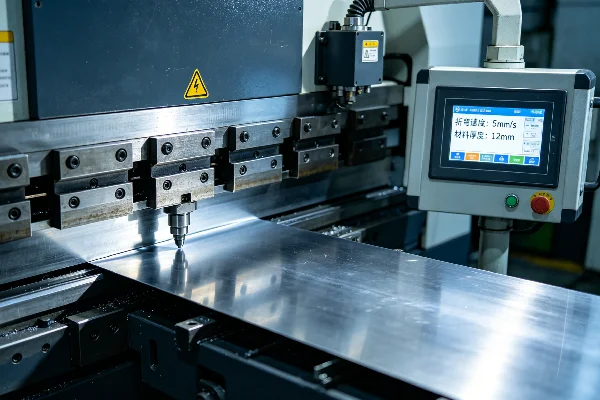
To really understand this, think about bending a plastic ruler. If you bend it slightly, it snaps right back to its original shape. That’s 100% elastic deformation. If you bend it so far that it stays bent but not broken, you’ve caused plastic deformation. Metal works the same way. During bending on a press brake6, we push the material past its elastic limit into its plastic range. But there's always a small amount of elastic energy left. Once the tool retracts, this energy is released, and the material springs back a few degrees.
Why is this a big deal? A 2-degree error on a single bend might seem small. But if that part has multiple bends, the errors add up. If it’s part of a larger assembly, like a photovoltaic mounting bracket or a home appliance chassis, these small deviations can make assembly impossible. It’s the difference between parts that fit perfectly and a pile of expensive scrap metal. Ignoring springback1 is one of the most common and costly mistakes in sheet metal fabrication4.
| Aspect | Description | Consequence if Ignored |
|---|---|---|
| Angular Deviation | The final angle is wider than the tool angle. | Parts do not align correctly in assemblies. |
| Dimensional Inaccuracy | Flange lengths and hole positions can shift. | Mating parts will not fit; fasteners misalign. |
| Cumulative Error | Errors from multiple bends compound each other. | The final part geometry is completely wrong. |
| Process Inconsistency | Different materials and thicknesses spring back differently. | A process that works for one part will fail for another. |
How Do You Calculate and Compensate for Springback?
You know springback1 is the problem, but how do you actually fix it? Guessing how much to overbend leads to inconsistent results and high scrap rates, eating into your profit margins.
We compensate for springback1 using precise methods like overbending2, bottoming7, or coining8. The most common is overbending2, where we form the part to a sharper angle than needed. The material then springs back to the perfect target angle. The exact amount is calculated based on experience and testing.
There’s no single magic formula for springback1, as it depends on so many factors. But there are reliable methods we use to control it. The goal is to force the material to "set" in its new shape with minimal elastic recovery.
Our primary method is overbending2. If a customer needs a 90-degree bend in a material that we know will spring back by 3 degrees, we set our press brake6 to bend the part to 87 degrees. When the pressure is released, the material springs back by 3 degrees, landing exactly at the desired 90-degree angle. This requires experience and often a few test pieces to dial in the exact compensation for a new material or thickness.
For other applications, we might use bottoming7 or coining8. In these methods, the punch presses the sheet metal with extreme force against the bottom of the V-die. This intense pressure compresses the material at the bend radius, reducing internal stresses and minimizing the springback1 effect. Coining is even more extreme and can actually thin the material at the bend.
| Compensation Method | How It Works | Best For |
|---|---|---|
| Overbending (Air Bending) | Bends the part to a sharper angle than needed, letting it spring back to the target angle. | Most common, flexible, and works for a wide range of materials and thicknesses. |
| Bottoming | The punch presses the material fully against the die walls with high tonnage. | Achieving consistent angles and reducing springback1 in medium-volume production. |
| Coining | Uses extremely high force to stamp the bend, thinning the material and setting a permanent angle. | High-volume production where precision is critical and springback1 must be eliminated. |
What Material Properties Affect Sheet Metal Bending?
Your springback1 compensation worked perfectly for a batch of mild steel parts. But when you run the same job with stainless steel9, the parts are all wrong. This is incredibly frustrating.
The most important material properties affecting springback1 are yield strength10 and the modulus of elasticity11. Materials with higher strength and hardness, like stainless steel9, will spring back significantly more than softer materials like aluminum12 or mild steel. Material thickness also plays a crucial role.
stainl
Every metal has a unique personality, especially when it comes to bending. You can't treat them all the same. As a factory that works with steel,ess steel9, aluminum12, and copper every day, we have a deep, practical understanding of how each one behaves.
Here’s a simple breakdown:
- Yield Strength: This is the point where the material stops being elastic (springing back) and starts deforming permanently. A material with a high yield strength10, like a hard temper stainless steel9, has a larger elastic range. This means it will want to spring back more after being bent.
- Modulus of Elasticity: Think of this as the material's stiffness. A higher modulus means the material resists bending more and has more "spring" in it. Steel has a much higher modulus than aluminum12, for example.
- Thickness: Thicker material is inherently stiffer. For the same bend radius, a thicker sheet will have more internal stress and therefore more springback1 than a thinner sheet of the same material.
This is why a one-size-fits-all approach to bending is doomed to fail. We have to adjust our process for every single combination of material type, temper, and thickness.
| Material | Typical Yield Strength | Springback Tendency | Common Use Case |
|---|---|---|---|
| Aluminum (e.g., 5052) | Low to Medium | Low | Enclosures, chassis, lightweight brackets |
| Mild Steel (e.g., A36) | Medium | Medium | Structural parts, general fabrication, furniture frames |
| Stainless Steel (e.g., 304) | High | High | Home appliances, food-grade equipment, outdoor enclosures |
| High-Strength Steel (e.g., 301 Hard) | Very High | Very High | Springs, clips, critical fasteners |
How Did We Solve a Real-World Bending Challenge for a UK Client?
Theoretical knowledge is great, but real projects have unique challenges. You might have a critical part that keeps failing quality checks, putting your entire project timeline at risk.
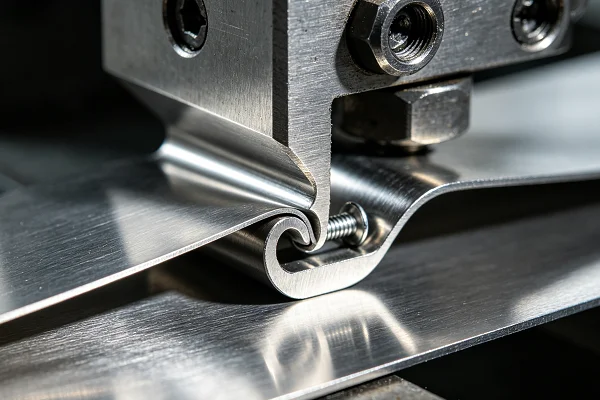
A UK client needed 0.5mm thick 301 stainless steel9 split pins with a precise 8mm opening. This hard material has extreme springback1. Our first test batch opened to 10mm. We solved this by precisely calculating the overbending2 needed and adjusting our tooling for a perfect result.
Let me walk you through a project that perfectly illustrates these challenges. A valued client in the UK, who specializes in high-end construction components, came to us with a new project. They needed a large quantity of custom split pins13. The part was small, but its function was critical. The material specified was 301 stainless steel9, full hard temper, at a thickness of only 0.5mm. The most critical dimension was the opening of the pin, which had to be exactly 8mm.
We knew this would be tough. 301 full hard stainless steel9 has a very high yield strength10 and is incredibly "springy." We ran a small test batch using our initial calculations. The result? The opening measured 10mm, a full 2mm wider than the required 8mm. This was completely unacceptable for the client's application.
Instead of guessing, our engineering team went to work. We used the data from the failed test run. The 2mm deviation told us exactly how much this specific batch of material was springing back. We recalculated our compensation factor and determined the precise overbending2 angle needed. We adjusted the press brake6 tooling to bend the pin to a much smaller opening, anticipating it would spring back. Our second test run was a success. The pins sprang back to land exactly on the 8mm target. We documented this process, ensuring every pin in the full production run of thousands of units was identical and perfect. This is the kind of problem-solving experience that gives our clients peace of mind.
Conclusion
Mastering sheet metal bending means controlling springback1. This requires understanding material properties, applying precise compensation techniques, and having the experience to solve real-world challenges. Partnering with an expert manufacturer minimizes your risks.
Understanding springback is crucial for achieving precision in metal fabrication, ensuring parts meet design specifications. ↩
Overbending is a key technique to compensate for springback, helping to achieve accurate angles in bent metal parts. ↩
Identifying causes of production delays can help manufacturers streamline processes and enhance productivity. ↩
Exploring best practices in metal fabrication can lead to improved efficiency and reduced costs in production. ↩
Identifying solutions to fabrication headaches can streamline production and improve overall efficiency. ↩
A press brake is essential for bending metal accurately; understanding its operation can enhance your fabrication process. ↩
The bottoming method is effective for achieving consistent angles and reducing springback in production. ↩
Coining is a precise technique used in high-volume production to eliminate springback and ensure accuracy. ↩
Stainless steel has unique properties that affect bending; understanding these can improve fabrication outcomes. ↩
Yield strength is a critical property that influences how materials behave during bending, impacting final part accuracy. ↩
Understanding the modulus of elasticity helps predict how different materials will respond to bending forces. ↩
Aluminum's properties make it a popular choice for lightweight applications; learn how to leverage its benefits. ↩
Manufacturing custom split pins requires precision; learn techniques to ensure quality and accuracy in production. ↩